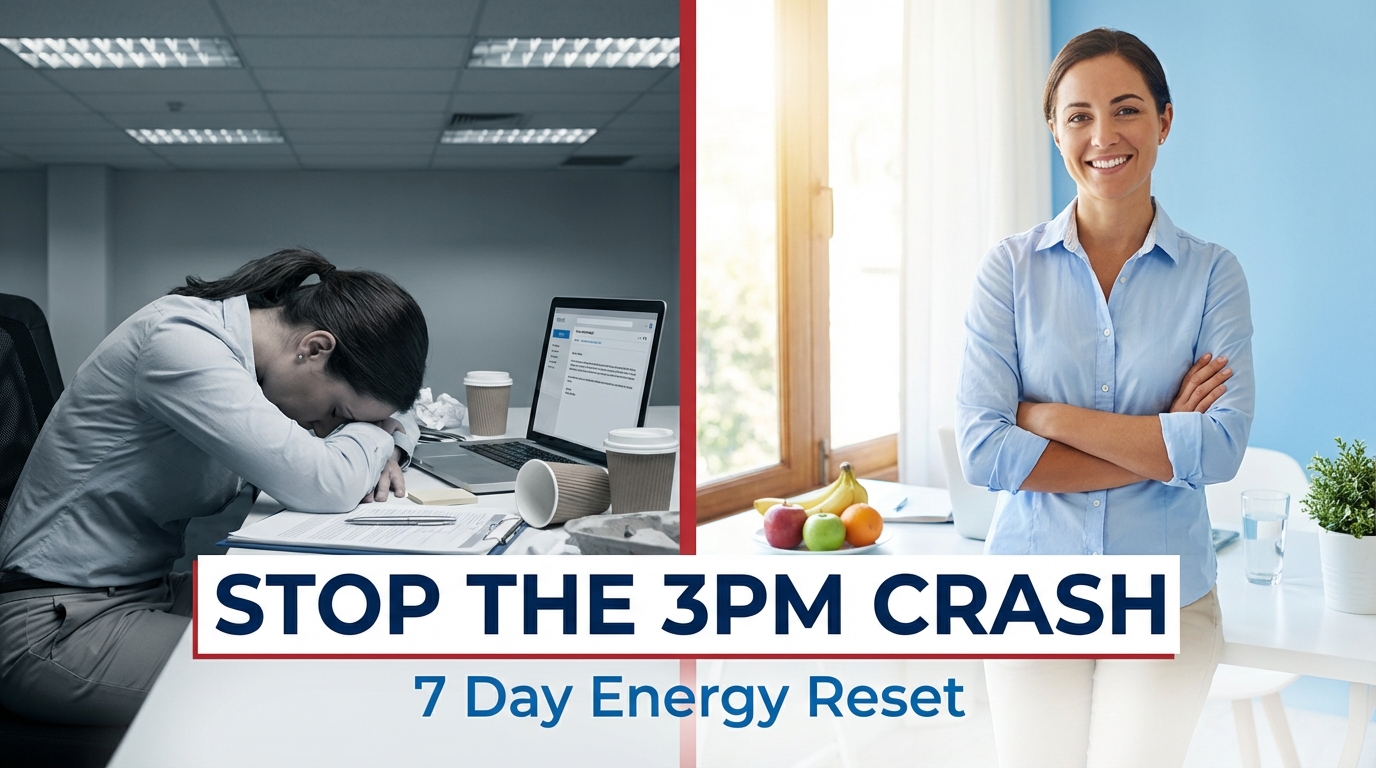
Why Your 3pm Energy Crash Is Actually a Warning Sign
Why Your 3pm Energy Crash Is Actually a Warning Sign (And How to Fix It in 7 Days)
The Daily 3pm Betrayal That's Stealing Your Life
It happens every single day, doesn't it?
You're cruising through your afternoon, handling work calls, managing the kids' schedules, maybe even feeling productive... and then BAM.
3pm hits like a brick wall.
Suddenly you're staring at your computer screen like it's written in ancient hieroglyphics.
Your eyelids feel like they're made of concrete.
That second (or third) cup of coffee isn't doing anything except making you jittery AND tired at the same time.
Sound familiar? 😴
Here's what most people don't realise: that afternoon energy crash isn't just about needing more sleep or better coffee.
It's actually your body waving a giant red flag, trying to tell you something important about your metabolic health.
And if you're over 40?
This daily energy nosedive could be the first warning sign of metabolic syndrome - a cluster of conditions that affects nearly 35% of adults and dramatically increases your risk of heart disease, stroke, and type 2 diabetes.
But here's the good news (and why I'm writing this): you can turn this around faster than you think.
No extreme diets, no 2-hour gym sessions, no giving up your favourite foods.
Just simple, science-backed strategies that work with your busy life, not against it.
What Your Energy Crash Is Really Telling You About Your Health
Your afternoon energy crash isn't random - it's your metabolism sending you a message.
When your energy tanks every day around the same time, it usually means one of two things is happening:
Your blood sugar is on a roller coaster.
You eat lunch, your blood sugar spikes, insulin rushes in to bring it down, and then... crash.
Your brain literally runs out of fuel, leaving you foggy, irritable, and desperate for sugar or caffeine.
Your stress hormones are burnt out.
Cortisol is supposed to keep you energised throughout the day, but chronic stress (hello, parenting and work deadlines!) can exhaust this system.
By mid-afternoon, your cortisol drops off a cliff, taking your energy with it.
Here's where it gets serious: these daily crashes are often the first sign of metabolic syndrome.
Metabolic syndrome isn't one disease - it's a cluster of conditions that include high blood pressure, elevated blood sugar, excess belly fat, and abnormal cholesterol levels.
If you have three or more of these markers, you're at significantly higher risk for heart disease, stroke, and diabetes.
But here's what really matters: metabolic syndrome doesn't happen overnight.
It develops gradually, often starting with exactly what you're experiencing - those daily energy crashes that make you feel like you're running on empty by mid-afternoon. 🔋
The good news?
Catching it at this stage means you can still reverse it completely.
And the best part?
The same strategies that fix your energy crashes also prevent and reverse metabolic syndrome.
The Real Culprits Behind Your Daily Energy Drain
Let me guess your typical day:
Coffee and maybe a pastry for breakfast (or you skip it entirely because you're rushing to get everyone out the door).
By 11am, you're hungry again, so you grab whatever's convenient.
Lunch is often eaten at your desk or in the car between kid pickups - probably something carb-heavy because you need "quick energy."
Then 3pm hits, and you're done. Absolutely done. 💀
Sound about right?
Here's what's really happening behind the scenes:
The Morning Sugar Spike
That pastry or sugary coffee drink sends your blood sugar soaring, which feels great... for about an hour.
Then insulin kicks in hard, dropping your blood sugar below where you started.
Result: you're hungrier and more tired than before you ate.
The Stress Eating Cycle
When you're constantly juggling deadlines and family responsibilities, your body stays in fight-or-flight mode.
This makes you crave quick energy (sugar and refined carbs) and stores everything as belly fat.
Meanwhile, your adrenal glands are working overtime, setting you up for that afternoon crash.
The Protein Problem
Most busy parents don't eat nearly enough protein, especially at breakfast and lunch.
Without adequate protein, your blood sugar stays unstable all day long.
Your muscles can't recover properly, and your metabolism slows down.
The Sleep Sabotage
Poor sleep disrupts hormones that control hunger and energy.
You wake up already behind the eight-ball, reaching for caffeine and sugar just to function.
The frustrating part?
You're probably doing everything you think is "healthy" - choosing salads, drinking lots of coffee, trying to eat less.
But these common strategies often make the energy crashes worse, not better.
The Simple Science of Stable Energy (No PhD Required)
Here's the thing about energy that nobody talks about: it's not about willpower or "pushing through."
It's about working WITH your body's natural systems instead of against them.
Your body has three main fuel sources: glucose (from carbs), fatty acids (from fat), and ketones (from stored fat).
When these systems work smoothly together, you feel energised and focused all day long.
When they're out of whack? Hello, 3pm crash. 📉
The Magic of Metabolic Flexibility
Think of your metabolism like a hybrid car that can switch between gas and electric.
A healthy metabolism can seamlessly switch between burning sugar and burning fat for fuel.
But when you're constantly eating sugar and refined carbs, your body forgets how to burn fat efficiently.
Result: you're dependent on constant refueling (more food, more caffeine) just to function.
Why Protein is Your Secret Weapon
Protein doesn't just build muscle - it stabilises your blood sugar for hours.
It takes more energy to digest protein than carbs or fat, which actually boosts your metabolism.
Plus, protein triggers hormones that make you feel satisfied and energised, not sluggish.
The Timing Factor
When you eat matters almost as much as what you eat.
Eating protein and healthy fats earlier in the day sets you up for stable energy.
Saving all your carbs for dinner works WITH your body's natural cortisol rhythm.
Here's what I love about this approach: you don't have to give up foods you enjoy.
You don't need to count calories or carry around meal prep containers.
You just need to understand how to time and combine foods so your energy stays rock-solid all day long. ⚡

Your 7-Day Energy Reset Blueprint
Okay, enough theory - let's get practical.
Here's exactly how to break the afternoon crash cycle and start feeling energized all day long:
Days 1-2: Foundation Reset
Start your day with protein within an hour of waking up.
This could be eggs, Greek yogurt, a protein smoothie, or even leftover chicken from dinner.
Skip the sugary coffee drinks and pastries - they're sabotaging you before 9am.
Drink water first thing (your body is dehydrated after 8 hours without fluids).
Days 3-4: Lunch Game Changer
Make lunch your power meal: protein + healthy fats + vegetables.
Think grilled chicken salad with avocado, or a turkey and cheese wrap with veggies.
Avoid the sandwich-chips-cookie combo that sends your blood sugar on a roller coaster.
If you must have carbs at lunch, pair them with protein and fat.
Days 5-7: The Afternoon Strategy
When 2:30pm hits (before the crash), have a small protein snack.
Apple with almond butter, a hard-boiled egg, or a handful of nuts.
This prevents the blood sugar drop that causes the 3pm crash.
Stay hydrated - dehydration mimics fatigue and makes everything worse.
The Sleep Connection
Get sunlight in your eyes within 30 minutes of waking up (even through a window counts).
This resets your circadian rhythm and improves both energy and sleep quality.
Dim the lights after dinner to help your body prepare for rest.
The Stress Buffer
Take three deep breaths before each meal.
This switches your nervous system from stress mode to digestion mode.
Even 60 seconds of intentional breathing can improve how your body processes food. 🧘♀️
The beautiful thing about this approach?
You'll likely notice improvements in just 2-3 days.
Better sleep, fewer cravings, and yes - no more 3pm energy crashes.
What to Expect (The Good, The Challenging, and The Amazing)
Let me be real with you about what the next 7 days will actually look like.
Days 1-2: The Adjustment
You might feel a little off as your body adapts to stable blood sugar.
If you're used to running on caffeine and sugar, you might experience mild headaches or fatigue.
This is normal and temporary - your body is literally learning how to use fat for fuel again.
Drink extra water and be patient with yourself.
Days 3-4: The Breakthrough
This is when most people notice the magic happening.
You'll wake up feeling more rested, even if you got the same amount of sleep.
That desperate 3pm coffee craving? It starts to disappear.
Your mood becomes more stable - less irritable, less anxious about food.
Days 5-7: The New Normal
Sustained energy becomes your default, not the exception.
You'll notice you can think clearly in the afternoon instead of feeling foggy.
Food cravings diminish significantly, especially for sugar and refined carbs.
Many people report sleeping better and waking up naturally without an alarm. 😴➡️😊
The Ripple Effects
Here's what surprises most parents: the benefits extend far beyond just energy.
You'll have more patience with your kids when you're not hangry at 4pm.
Work productivity improves because you're not fighting brain fog all afternoon.
You might even notice your clothes fitting better as inflammation decreases.
Common Challenges (And How to Handle Them)
"I forgot to eat breakfast"- Keep hard-boiled eggs or protein bars handy for grab-and-go mornings.
"I'm too busy to prep snacks"- Buy pre-made options like nuts, cheese sticks, or protein drinks.
"My family thinks I'm being dramatic"- Let your improved energy and mood speak for itself.
Remember: you're not just fixing an energy problem.
You're potentially preventing metabolic syndrome, diabetes, and heart disease.
That 3pm crash was your body's way of asking for help - and now you're finally listening.
Your Next Step: The Complete The Parent's Guide to Beating the 3pm Crash Forever
Look, I could keep explaining the science behind energy crashes and metabolic syndrome.
I could tell you more about insulin resistance and cortisol patterns and circadian rhythms.
But here's what I've learned after helping hundreds of busy parents over 40: information without implementation is just entertainment.
You don't need more knowledge - you need a clear, step-by-step plan that fits your real life.
That's exactly what I've created for you.
The Parent's Guide to Beating the 3pm Crash Forever gives you everything you need to break the afternoon crash cycle permanently:

✅Daily meal templates that require zero meal prep but deliver all-day energy
✅The exact timing strategy for eating that works with your natural hormone cycles
✅Emergency energy protocols for those days when everything goes sideways
✅Simple sleep optimisation that doesn't require a complete lifestyle overhaul
✅Stress-busting techniques you can do in under 2 minutes (perfect for busy parents)
This isn't another generic "eat less, move more" program.
This is specifically designed for parents who are juggling careers, kids, and the constant demands of modern life.
You'll know exactly what to eat, when to eat it, and how to maintain steady energy even on your most chaotic days.
Ready to say goodbye to 3pm crashes forever?
Your body has been trying to tell you something important with those daily energy dips.
It's time to listen - and take action.
Click below to get your complete Parent's Guide to Beating the 3pm Crash Forever and start feeling like yourself again. ⚡
Get Your Parent's Guide to Beating the 3pm Crash Forever Now